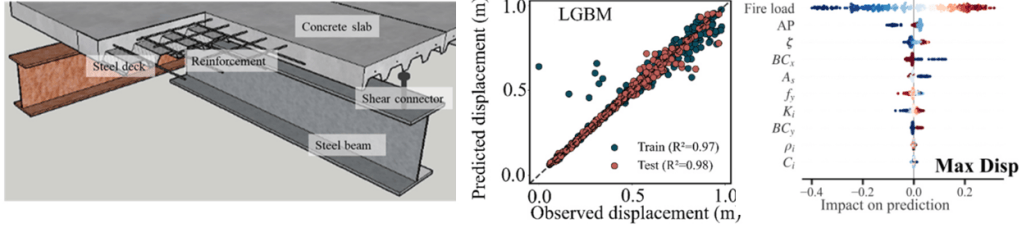
ML-based fire performance evaluation of composite flooring systems
Collaboration with John Hopkins University (Prof.Gernay) and UNL (Prof.Ma)
Graduate student: Ali Namin
We developed explainable machine learning surrogates to support performance-based fire assessment of composite steel–concrete flooring systems. The framework captures system behavior, including load redistribution and tensile membrane action, while reducing the computational demands of repeated nonlinear thermo-mechanical analyses. Using simulations validated against full-scale fire tests, we trained and compared regression and classification models to predict floor displacements and damage states from structural design parameters and fire conditions. Ensemble boosting methods, particularly LightGBM and XGBoost, provided the strongest predictive performance. Explainability analyses identified fire load as the dominant driver of maximum and residual displacements, with slab geometry and ventilation conditions also influencing peak response. The importance of structural features shifted with damage severity: floor aspect ratio was more influential at lower damage states, whereas reinforcement ratio and boundary conditions became increasingly important at higher states.
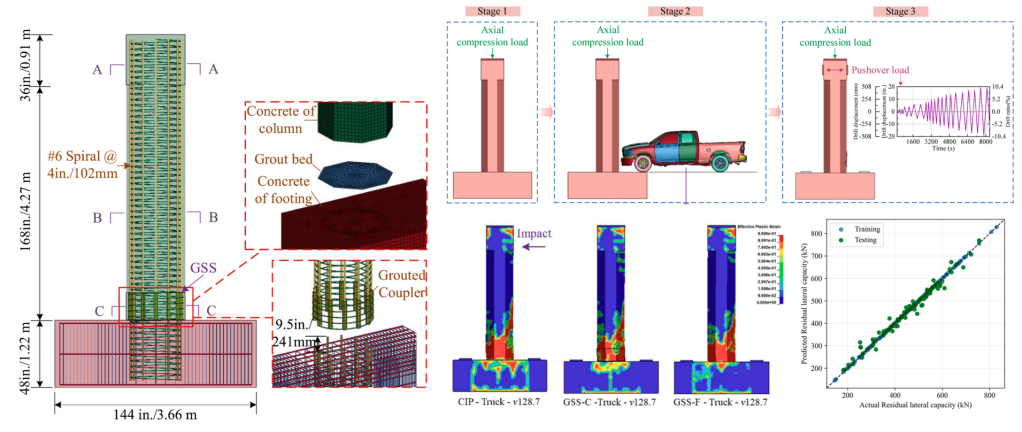
Evaluating precast concrete bridge piers under sequential vehicular impact and seismic loading using a boosting model
Funded by the Mountain-Plains Consortium UTC, Collaboration with Texas A&M University (Prof.Sorensen)
Graduate student: Jinghui Jiang
This project combined nonlinear finite element simulation and explainable machine learning to evaluate how vehicle collisions affect the subsequent seismic capacity of precast concrete bridge piers. Impact damage within grouted splice sleeve connections can remain visually undetected while compromising performance during a later earthquake. Using LS-DYNA, a dataset of 318 simulations were created covering cast-in-place piers with precast configurations featuring sleeve connectors in either the column or footing under sequential impact and seismic loading. The data was then used to develop an XGBoost predictor, with SHAP analysis used to interpret the influence of design and loading parameters on residual capacity. The model suggested that placing sleeve connectors in the footing provided greater residual capacity under sequential loading than placing them in the column, which is different from seismic-only behavior.